

Written by Stuart Elmes
The Future Homes Standard (FHS) consultation response was published on 24th March 2026. The new regulations will make renewable electricity generation (solar PV) mandatory on all new homes in England, and will also increase the amount of solar on each roof relative to homes built today. The solar industry is looking forward to a significant increase in demand from new housing, but how long will it take for the new regulations to feed through into bricks and mortar on the ground, and more importantly solar panels on the roof?
The transitional arrangements which apply to the new regulations are intended to strike a balance between giving developers time to get ready to deliver the new housing specification at scale and making sure that the new rules apply as quickly as possible to all homes. The first deadline is March 24th 2027. Housing developments that apply to Building Control after this date will see all homes on that development built to the new regulations.
A second deadline follows one year later in March 2028. After this date all homes not yet “commenced” will need to be built to the FHS, irrespective of when the Building Control application was lodged.
In attempting to estimate how quickly the change will happen we can use the last building regulations transition as a model because the transitional arrangements for the FHS are the same as those that applied when the last update to the building regulations for energy efficiency came in – Part L 2021.
How Part L 2021Rolled Out
The last update to Part L was announced in 2021, with a starting date of July 2022 for new sites and July 2023 for all houses not yet commenced.
The image above shows how this turned out in practice. It is based on a dataset published by the Ministry of Housing and Local Government (MHCLG) that I analysed in more depth for an earlier blog (Solar PV and the Part L 2021 Transition). I have stripped out flats and apartments, which can include very long projects, so we are looking only at the proportion of new houses and bungalows built to Part L 2021. These are shown in the light green.
You can see that the ramp for the changeover did not really begin until mid 2024. By March 2026, we had reached a level where 85% of new homes that month were completed to the new regulations. Given that all new developments after July 2022, and all houses started after July 2023 were supposed to be build to the new regulations, how is it that some three years later we are still not building all new homes to the new regulations? In the past, developers raced to lodge as many applications for new sites with building control to beat the deadline, but how had they managed to delay the new regulations under transitional arrangements that also swept in homes not yet started after July 2023?
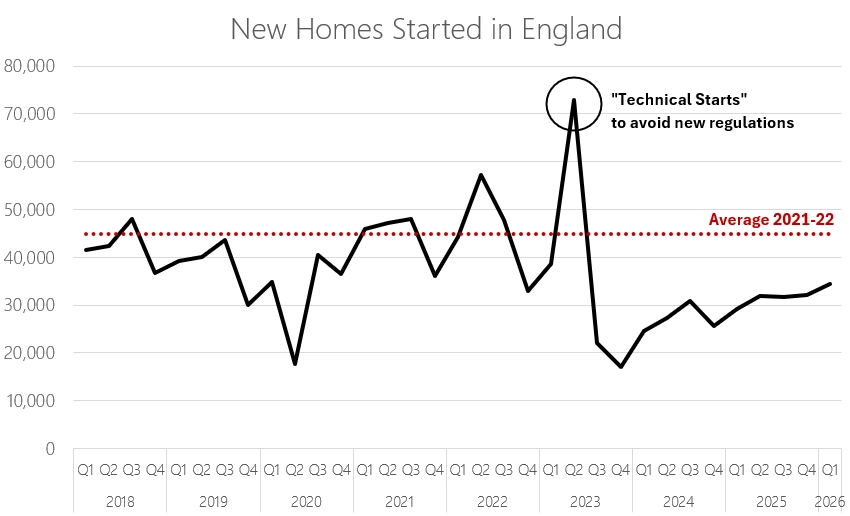
The clue to the answer to this question is found by looking at another set of government statistics that show housebuilding starts and completions in England. There was an unusual spike in housing starts in the run up to the June 2023 cut-over date (shown in the chart below). Housebuilders commenced 30,000 more houses than in a normal quarter. Strip foundations were excavated and concrete poured to classify plots as commenced. These foundations were then mothballed for many, many months before being built on later – locking in the older, and lower-cost regulations.
What This Means for the FHS
A home built to meet the specification in the FHS will have a higher cost than a home built to current regulations, around £5,000 per house according to the Government’s own Impact Assessment. So the incentive to engineer a delay and build as many homes as possible to the old regulations before switching over will be there, just as it was for Part L 2021.
However, there are differences this time around and these could influence how long the transition takes.
First, shortly after developers rushed to put in foundations ahead of the last deadline, an spike in borrowing rates negatively impacted mortgage availability and slowed the housing market. As a result, the foundations lasted longer than they would have if the housebuilders were building at a more normal rate.
Second, the definition of what constitutes “commencement” changed in late 2023, or rather it was clarified. Before this, what qualified as a house that had started construction was open to interpretation by local building control. The new definition requires that the first floor structure is complete. This may change the financial calculation for a developer. Taking the example of a house with a concrete slab ground floor, in addition to the cost of the foundation you can now add the cost of building the walls below ground, a base-layer of hardcore and blinding and then pouring a concrete slab, plus all the drainage and service ducts. More money would have to be spent, more cash tied up for the developer.
Will this second change be enough to change the financial calculation of how many houses to start before the regulations bite? Given the size of the prize from the cost saving, it’s hard to see why the housebuilders won’t just repeat what they did for the 2021 regulations. My prediction for the FHS is shown on the chart in the darker green.
I am predicting the start of the ramp in June 2028, running through to the end of 2030.